Posts

Showing posts with the label J. Todd Billings

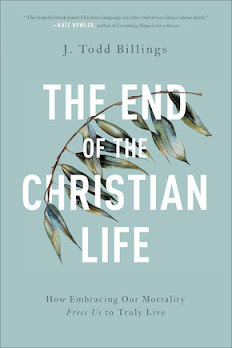
"The End of the Christian Life" by J. Todd Billings. A Review
Image
  The End of the Christian Life: How Embracing Our Mortality Frees Us to Truly Live J. Todd Billings Brazos Press ISBN: 9781587434204; September 2020; $19.99   Today, it came at me again. I was teaching a small group of people at our State Capitol and we were hunkered down examining James 4:13-17. James was correcting the brazen outlook that thinks we have control of our lives and our outcomes, while not having God anywhere in the equation (4:13). And part of James’s remedy was to point out that in light of our brevity (4:14) what we should say is, “If the Lord wills, we will live and do this or that” (4:15). If the Lord – the Lord Jesus Christ (1:1 and 2:1) wills, we will live…and then engage in our activities. And that thought is what “The End of the Christian Life: How Embracing Our Mortality Frees Us to Truly Live” occupies itself with in 240 softback pages. The author, J. Todd Billings, Gordon H. Girod Research Professor of Reformed Theology at Western Theological...

"Remembrance, Communion, and Hope" by J. Todd Billings. A Review

Image
Remembrance, Communion, and Hope: Rediscovering the Gospel at the Lord's Table by J. Todd Billings My rating: 5 of 5 stars There’s only so much you can say about J. Todd Billings, Gordon H. Girod Research Professor of Reformed Theology at Western Theological Seminary in Holland, Michigan, ordained minister in the Reformed Church in America, and accomplished author. You either like him, or you like him. It’s just that plain and simple. And recently Billings gave us one more reason to like him with his newest 237 page softback, “Remembrance, Communion, and Hope: Rediscovering the Gospel at the Lord's Table”. This fine treatise on the Lord’s Supper is written to attract the attention and affections of professors, pastors and parishioners. And it is composed to present readers and leaders with a wager: “that a renewed theology and practice of the Lord’s Supper can be an instrument for congregations to develop a deeper, more multifaceted sense of the gospel itself…the Supper is ...

"Rejoicing in Lament" by J. Todd Billings. A Review

Image
Rejoicing in Lament: Wrestling with Incurable Cancer and Life in Christ by J. Todd Billings My rating: 5 of 5 stars C.S. Lewis once stated, “If you do not listen to theology, that will not mean that you have no ideas about God. It will mean that you have a lot of wrong ones – bad, muddled, out-of-date ideas” (“Mere Christianity,” 128). But for many people theology is simply dusty, drab, dispassionate, desiccated drivel. And then into the mix life happens, or death, bringing tragedy and theology to meet and clash in the sparring ring. It’s right here, in all of the sweat, the grit and the grappling, that J. Todd Billings, research professor of Reformed Theology at Western Theological Seminary in Holland, Michigan, and ordained minister in the Reformed Church in America, presents his own, very personal , tussle with life-threatening cancer and life-enriching theology . His soon to be published 224 page paperback, “Rejoicing in Lament: Wrestling with Incurable Cancer & Life in Chri...

Book Review: "Calvin's Theology and its Reception" - 5 Stars

Calvin’sTheology and its Reception: Disputes, Developments and New Possibilities J. Todd Billings and I. John Hesselink, editors Westminster John Knox Press 100 Witherspoon Street Louisville, KY 40202-1396 www.wjkbooks.com Copyright 2012 ISBN: 978-0-664-23423-3; $30.00 Reviewed by Rev. Dr. Michael Philliber, Assistant Pastor, Heritage Presbyterian Church (PCA), Edmond OK 5 Stars The ripple-effect of Calvin’s thinking has sent it’s subtle, and not so subtle, waves into many corners of the Christian lake. An excellent example of the various ways this has happened are elucidated in “ Calvin’s Theology and Its Reception: Disputes,Developments and New Possibilities ”, edited by J. Todd Billings and I. John Hesselink. This manageable, 250 page paperback, is written for seminarians, pastors, thinkers and theologians, while being accessible enough for the thoughtful lay reader. The editors, who also authored two of the chapters, have set up five sections that cover ...

Aroused by Christ’s Double-Grace

In my previous post ( Too Much of a Good Thing? ) I dealt a bit with how there are folks within my own clan within the Christian tribe who seem to foster a “let go and let God” mindset with regard to sanctification. I used a specific example from Steve Brown and his book, “Three Free Sins”. As I tried to show, he (and others) are correct in their emphasis on the liberal love of God announced in the Gospel of Jesus Christ. But I also attempted to show where they go too far, by having the Gospel promises swallow up and neutralize all the directives in the Sacred Scriptures. In this post I will endeavor to show the beauty of sanctification that explodes in splendor from the liberating love of God in Jesus Christ. To begin with, a simple perusal of Paul’s writings will show the connection between the gracious Gospel and healthy holiness. Take the letter of Paul to the Ephesians, for one example. In the first three chapters, Paul clearly articulates what God has done for us in Christ,...

Book Review: "Union with Christ" by J. Todd Billings, 4 1/2 Stars

Union with Christ: Reframing Theology and Ministry for the Church J. Todd Billings Baker Academics Copyright: 2011 ISBN: 978-0-8010-3934-8; $19.99 I’ve heard it said that most preachers have only one sermon, delivered in hundreds of different ways throughout their ministry. J. Todd Billings is a theologian with one, central theme that rings out in many of his works, and is the point of his most recent piece, “Union with Christ: Reframing Theology and Ministry for the Church.” This short 180 page paperback is the work of a skilled craftsman hammering out further applications and repercussions of his chief message - union with Christ. As Billings notes toward the close of his book, “Union with Christ is a biblical, catholic, and Reformational theme that has astonishing implications for our identity” (173). This is a great read for pastors, theologians, and other serious church leaders. Billings opens the subject with an introduction that describes what he’s about to dish out in t...

Here, At the End of 2010 (Jeremiah 6.14-16)

[Note: Here at the end of 2010, I felt it was appropriate to present to you some of the things I said at the Reformation Theological Conference on Nov. 6.] In what we are about to read, you must recognize what the people were doing. They are often pictured as following the dictates of their own heart (9.14), taking their direction from their own internal desires, to the point that they had made their own words divine oracles (23.36). The result was public pandemonium & ethical upheaval. Into this environment God speaks: Jer. 6.14-16. “They have also healed the hurt of My people slightly, saying, ‘Peace, peace!’ when there is no peace. Were they ashamed when they had committed abomination? No! They were not at all ashamed; nor did they know how to blush. Therefore they shall fall among those who fall; at the time I punish them, they shall be cast down,” says the LORD. Thus says the LORD: “Stand in the ways and see, and ask for the old paths, where the good way is, and walk in it; t...

Billings: “The Word of God for the People of God” - Pt 2

One of the primary premises espoused in “The Word of God for the People of God,” is that there is a proper way to approach Holy Scripture. To begin with, the Bible reader needs to come with humility. She is not a technician who manufactures meanings out of Scripture, or manipulates and controls the outcome of this Word of God, but that through Scripture “God “reads” us, reshaping us into Christ’s image by the Spirit’s power” (80). Instead of Christians owning the truth, we are owned by the One who is the truth (82), which means that as the Word of God comes to inhabit us and our cultural context, it will often critique and challenge us and our cultural context (108). Therefore, coming to Scripture in this expectant humility, there is renunciation and transformation, for “reading Scripture is about being mastered by Jesus Christ through a biblical text that functionally stands over us as the word of God, not under us as a word we can control, rearrange, and use for our own purposes” (20...

Billings: “The Word of God for the People of God” - Pt 1

I ran across this guy while playing online chess. He identified himself as an Orthodox Jew in Canada and asked me a question, “I see you’re a Christian minister. How do you Christians interpret Scripture?” It was an excellent question I thought. We had a nice, short discussion. The major answer I gave him came as a direct quotation from J. Todd Billings’ recent book “The Word of God for the People of God: An Entryway to the Theological Interpretation of Scripture”, Wm. B. Eerdmans Publishing Co., 2010. Billings writes, “”Jesus was not just a great teacher, nor was he just God with limbs and a mouth. In Jesus, the whole history of Israel--and through Israel, humanity--was recapitulated, or lived again. But this time the one who was true Israel and true human being did not take the path of the first Adam. As the second Adam, Christ was the righteous one, the perfect human covenant partner. But this perfect covenant partner was also the Word incarnate, the one in whom the fullness of d...

Theosis, Participation in Christ, Billings and Fairbairn

I am recommending 2 books that should be read together. These are probably more for the scholastically minded pastors and academically placed professors. The first is written by a professor at Erskine Theological Seminary, Dr. Donald Fairbairn: "Life in the Trinity: An Introduction to Theology With the Help of the Church Fathers", published by IVP. This 240 page book is a Gospel-Driven, Gospel-Defined work that guides the reader through some important themes in the early Church pastors/theologians. Fairbairn primarily focuses on four big players; Irenaeus, Athanasius, Augustine and Cyril of Alexandria. He does reference a few others, but primarily works with these four. The central theme has to do with the ancient notion of theosis or participation. Fairbairn has done a nice job weaving classic Protestant teaching (justification, sanctification etc) into and flowing from participation in Christ. This leads me to the next book, published by Oxford Press. It's a rather ...