Posts

Showing posts with the label Martial Arts

"What Martial Arts Taught Me about the Gospel of Jesus Christ" by Glyn Norman. A Review

Image
  It's a very simple work. Glyn Norman is a Presbyterian minister serving at Trinity United Presbyterian Church (ECO) in Santa Ana California and martial artist. He has pulled together a few of his experiences in Jiu-Jitsu and Tae Kwon Do and parabolically used them as explanations of some basic aspects of the Gospel of Jesus Christ. "What Martial Arts Taught Me about the Gospel of Jesus Christ: Spiritual Lessons from the Dojo" is a 54-page soft back that "is an attempt to explain how some elements of martial arts relate very neatly to the practices of Christianity" (1). Easy-to-read, this could be helpfully digested by teens to senior citizens, especially those who have an interest in the martial arts. The few topics covered in this manual include humility, discipline, evil, responsibility, and perseverance. These chapters weave in some of Norman's personal experiences in Jiu-Jitsu and Tae Kwon Do, with different aspects of the Christian life. There are eve...

"Body Opponent Bag Combinations" by Sammy Franco. A Review

Image
Body Opponent Bag Combinations: A Newbie to Expert Guide to Body Opponent Bag Combinations and Workout Routines by Sammy Franco My rating: 5 of 5 stars The book is very simply what it says it's about, it's a 192 page softback handbook that guides a practitioner through various routines and combination punches (or punches, grabs and kicks) on a Body Opponent Bag (BOB). This simple-to-read-easy-on-the-eyes manual is condensed from the author's larger books on utilizing a BOB in honing your martial skills. Sammy Franco, founder and creator of Contemporary Fighting Arts and accomplished author, mixes in boxing, martial arts, a small amount of grappling and kick-boxing to round out his book's program. "Body Opponent Bag Combinations" is set up to take newbies to the intermediate level, and intermediates to the advanced. A reader doesn't need to have any fighting training to gain from the book, though it does help. The idea appears to be that wherever you ...

"Research of Martial Arts" by Jonathan Bluestein. A Review

Image
Research of Martial Arts by Jonathan Bluestein My rating: 4 of 5 stars “Research of Martial Arts” is compiled by Jonathan Bluestein, author, martial arts teacher and founder of the Tianjin Martial Arts Academy where he teaches the traditional Chinese martial arts of Xing Yi Quan and Pigua Zhang. This 418 page monograph is a massive manual clearly composed over several years. It is ideally suited for martial artists looking for detailed and technical background information on external and internal martial arts. “Research of Martial Arts” has three sections, one that is highly didactic, a second that is reflective and the final which is a record of six in-depth interviews with master martial artists. Bluestein meticulously weighs the pros and cons of the external and internal styles. Though it is clear that the author’s own preference is for the internal arts, yet he gives due consideration to the external and acknowledges “that there is no right or wrong in different approaches to tr...

"Five Years One Kata" by William Burgar. A Review

Image
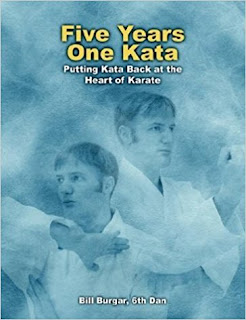
Five Years One Kata: Putting Kata Back at the Heart of Karate William Burgar Martial Arts Publishing Limited http://martialartspublishing.co.uk/ ISBN: 978-0954446604; March 2003; $29.95 4 Stars out of 5 Many martial art schools use katas, Poomsae, or forms, with minimal instruction as to what each technique is for. Some traditions seem to do better than others in this regard. One of my most memorable moments in kata came when an instructor spent a whole class session walking us through the five opening steps of an advanced form. During this time he explained each movement’s defensive and assaultive uses. And then he worked us through applying the techniques on our fellow karateka. This left a lasting impression on my mind as to the value of, and intent behind, kata learning. Several years back William Burgar, sixth dan in Shotokan karate, complied “Five Years One Kata: Putting Kata Back at the Heart of Karate”. This 336 page manual chronicles his five year experiment of focusing ...

"Karate Science: Dynamic Movement" by J.D. Swanson. A Review

Image
Karate Science: Dynamic Movement by J.D. Swanson My rating: 5 of 5 stars Class after class instructors direct you to punch this way, kick that way, stand like this, and block over here. Sometimes there are explanations on the physical dynamics and how energy is developed and delivered; but those explanations, in my experience, are rare. The lack of guidance on body mechanics in much of martial arts teaching can be remedied by the new 240 paperback "Karate Science: Dynamic Movement" produced by Dr. J.D. Swanson, Associate professor in the Department of Biology and Biomedical Sciences at Salve Regina University, Newport, RI, and fifth dan with the International Shotokan Karate Federation. This fine manual has in mind both the newest and the more seasoned karateka, and is helpfully enhanced by the artful illustrations of Sam Nigro. In a nutshell "Karate Science" is the application of Swanson's scientific background in physiology and kinesiology to the four marti...

"Essential Book of Martial Arts Kicks" by Marc De Bremaeker and Roy Faige. A Review

Image
Essential Book of Martial Arts Kicks: 89 Kicks from Karate, Taekwondo, Muay Thai, Jeet Kune Do, and Others [DVD Included] by Marc De Bremaeker My rating: 5 of 5 stars When I first started martial arts several years ago I couldn't figure out why the instructor paid such detail to the way I kicked, the exact placement, chambering, execution and timing. It wasn't until I entered my first sparring match that I began to recognize that sloppy kicks do little more than annoy, but well executed kicks deliver a wallop. Now as a second degree black I strive to develop better kicks. So I was delighted when I picked up a copy of Marc De Bremaeker's and Roy Faige's satisfying 256 page manual "Essential Book of Martial Arts Kicks," accompanied with an instructional DVD, from the local public library. As the authors note, this "book is not a "how to" book for the neophyte, but a reference work for the experienced martial artist" (8). This is one instal...

"Low Kicks" by Marc De Bramaeker. A Review

Image
Low Kicks: Advanced Martial Arts Kicks for Attacking the Lower Gates by Marc De Bremaeker My rating: 4 of 5 stars Marc De Bremaeker, a seasoned martial artist, instructor and author, has crafted a 160 page handbook, "Low Kicks". It is one in a line of publications which focuses on specific aspects and regions of kicking. This particular volume is primarily about using kicks in the lower half of an opponent, from the mid-section to the foot. Karate-ka, whether experienced or novices, will find it an insightful book pulling from various martial arts traditions. And the non-initiated can gain from it as well. "Low Kicks" is in need of a good editor, to help clean up the numerous grammatical faux pas. The pictures - both photographs and sketches - are small, and not always clear. Nevertheless, if the reader can look past those glitches, they will be well instructed from the manuscript, and feel like their money has been well spent. The kicks covered in the material p...

"Cane Fighting" by Sammy Franco. A Review

Image
Cane Fighting: The Authoritative Guide to Using the Cane or Walking Stick for Self-Defense by Sammy Franco My rating: 5 of 5 stars I have walked with a cane for years, usually for comfort (not medical reasons...yet) and as a means to have something in hand if ever assaulted by four-legged or two-legged animals. Therefore my interest was piqued when I read the back cover of this book. Sammy Franco, founder and creator of Contemporary Fighting Arts (CFA), Law Enforcement Master Instructor, and author of 35 books on various aspects of reality based self-defense, has put together a simple manual on how to use a cane or walking-stick in personal protection situations. This snazzy, 233 page paperback is written for trained martial artists and the average citizen who has no training. "Cane Fighting" is easy to read and straightforward. The pictures are clear, the instruction is coherent, and the material is comprehensible. The seven chapters walk the learner through cane selectio...

"Combat Hapkido" by John Pellegrini. A Review

Image
Combat Hapkido: The Martial Art for the Modern Warrior by John Pellegrini My rating: 5 of 5 stars It can't be easy to come up with a "new" martial art, get it honed and proven by other martial art masters, and recognized by the World Kido Federation. But John Pellegrini, 9th Dan in Hapkido and Tae Kwon Do, founder and president of numerous martial arts institutions, and accomplished author, has not only crafted a new form of Hapkido, but he has manufactured a book that gives a good sense of his system. "Combat Hapkido: The Martial Art for the Modern Warrior" is a glossy, magazine-sized 150 page manual published in 2009, to promote his system and give the practitioner a feel for it. This handbook is not too wordy, but has enough verbal detail to explain the history of Combat Hapkido, some of its genealogy, and three of its primary principles. Most of the material are sequential photographs that are clear and walk the karateka easily through numerous techniques...
Image
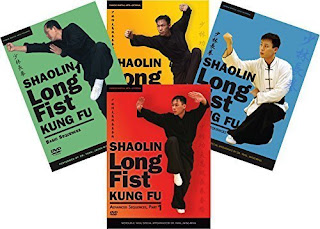
Shaolin Long Fist Kung Fu 4-DVD Set Dr. Yang, Jwing-Ming and Nicholas C. Yang YMAA Publication Center, Inc. PO Box 480 Wolfeboro, NH 03894 ISBN: 9780940871633; 9781594391071; 9781594393021; 9781594392313; $169.99 5 stars of 5 Historical and Instructional Where does a particular martial art come from? How did it develop and why? Is there a genuine rationale beyond these sequences? How can a particular succession of steps and strikes be employed in real-life real-time situations? These are just a few of the questions an astute martial artist asks when pursuing their particular tradition so as to beef up and fortify the value of what they are being trained in. Since 2005 Dr. Yang, renowned author and teacher of Chinese martial arts and Qigong, and Nicholas Yang, award winning martial artist in bare-hand and weapons, have been composing and compiling a four volume DVD series that has been bundled together as the “Shaolin Long Fist Kung Fu 4-DVD Set”. These instructional...

"The Art and Science of Staff Fighting" by Joe Varady. A Review

Image
The Art and Science of Staff Fighting: A Complete Instructional Guide by Joe Varady My rating: 5 of 5 stars Most martial art streams teach some form of staff fighting and forms. Sometimes there’s rationale given, and at other times it’s simply, “Do this and make it look good.” The value of learning the staff varies from school to school. Joe Varady, award winning martial artists, instructor and accomplished author, has pulled together this 203 page softback manual, “The Art and Science of Staff Fighting: A Complete Instructional Guide” to strengthen the ability of the karateka. It is a how-to handbook that covers bo staff, quarter staff, disarming techniques, and unarmed-against-a-staff. “The Art and Science of Staff Fighting” takes the learner through nine progressive levels of staff training, beginning with the fundamentals and traveling all the way to the use of a spear, because a spear “is simply a staff equipped with a power multiplier” (159). Clear pictures, directional arrows...

"The Ultimate Martial Arts Encyclopedia" ed. John R. Little and Curtis F. Wong. A Review.

Image
Ultimate Martial Arts Encyclopedia by John  Little My rating: 3 of 5 stars Quite the spiffy and informative book. It's small for an encyclopedia, but covers a wide range of martial arts' history and rational. With regard to it being "ultimate," the authors must have used this word to describe, not the depth of material, but the breadth of the subject. No singular martial art is covered deeply, but the authors spread out to cover numerous modern and ancient styles, as well as from different continents: Asian, European and African. Beyond the subject matter on the different styles, there are chapters to inform and help broaden the thinking, perception and motivation of the martial artist. These chapters are nicely written, drawing out finer points, and explaining the importance of more technical elements in punches, kicks, and blocks. For example, there's the chapter that emphasizes the fluidity and artfulness of any particular technique, so that "a lock ...

"Taekwondo Grappling Techniques" by Tony Kemerly and Steve Snyder. A Review

Image
Taekwondo Grappling Techniques: Hone Your Competitive Edge for Mixed Martial Arts [DVD Included] by Tony Kemerly My rating: 3 of 5 stars The upside to this book is that it draws out several combative and grappling aspects from various Taekwondo movements. The author demonstrates these maneuvers from twelve different katas, and translates them into throws, breaks, arms holds, chokes, and submission holds. The pictures and explanations are fairly easy to follow. The downside is that the Jujitsu applications of the Taekwondo movements seems forced and artificial. There are several times when the moves translate easily from Taekwondo to Jujitsu. There are other times when the Taekwondo positions and sequences are clearly being stretched beyond their intended use. And finally a few of the throws or chokes are well outside of the initial flow. In the end this book is about 50/50. A martial arts instructor could use it as a prompt to help make some sample applications to different steps in...

"Yang Tai Chi for Beginners (DVD)" By Dr. Yang. Jwing-Ming. A Review

Image
Yang Tai Chi for Beginners (DVD) Dr. Yang, Jwing-Ming YMAA Publication Center, Inc. PO Box 480 Wolfeboro, NH 03894 www.ymaa.com ISBN: 978-1-59439-230-6; February 2012; $29.95 Steady and Sequential: 5 of 5 Stars Tai Chi is spreading through the United States like a dust storm blowing across the Oklahoma plains! I have seen versions of it surface in adult care facilities, libraries, yoga centers, YMCAs, and hospitals. But what is the meaning of Tai Chi, its various purposes, and its benefits? All of those questions, and more, are answered in the 293 minute instructional DVD, “Yang Tai Chi for Beginners,” by Dr. Yang, Jwing-Ming, award-winning martial artist and instructor. Dr. Yang, Jwing-Ming walks the learner/viewer through the longer form of Yang style Tai Chi, a form that includes 37 postures and 113 stances. Though the thought of learning 113 stances may sound daunting, the majority of the steps are repeats of the 37 postures being done in several different...

"Mastering Tae Kwon Do Self-Defense" (DVD) by Grand Master Jong Soo Park. A Short Review

Image
A one hour long video by Grand Master Jong Soo Park. The visual quality is good and easy to watch. The instruction on various self-defense moves is easy. The number of self-defense applications is plentiful, and easy to grasp. You don't need to be a trained martial artist to benefit from this video. You will need another person to practice with, and practicing will be important.I didn't see any defense against weapons in this video, contrary to the content blurb. Nevertheless, several of the moves can be useful in a limited set of weapons assaults. This video would make a useful idea-starter for a martial arts instructor to enhance their classes with a section for self-defense - there's enough material here to last through quite a few class sessions! The DVD will also make a nice gift for your favorite karateka. I happily recommend the DVD. You can find it here: http://tinyurl.com/j6aeayv Mike

"Solo Training 3: 50 and Older" by Loren W. Christensen. A Review

Image
Solo Training 3: 50 and Older by Loren W. Christensen My rating: 5 of 5 stars I started martial arts just at the end of my 40s and have recently earned my 2nd degree black belt. It has been sitting in the back of my aging noggin that the day may be soon approaching when I might need to move to something easier, lighter and more gentle on my mellowing physique. So I was quite interested when I picked up "Solo Training 3: 50 and Older" by Loren W. Christensen, 8th Dan in American Free Style Karate, retired Law Enforcement Officer (LEO), and senior citizen. This 316 page self-published paperback goes right to the heart of what I've been thinking, and gives a resounding "No!" to my question. Christensen lays out a rationale and regimen for starting on martial arts or continuing your training even beyond 50, 60 and into the 70s. It's a motivating read with helpful practicalities and reasoned purposefulness. The book contains truck loads of descriptive informat...

"The Shotokan Karate Bible: Beginner to Black Belt" by Ashley P. Martin. A Review

Image
The Shotokan Karate Bible by Ashley P. Martin My rating: 5 of 5 stars As a 2nd degree black belt in Tae Kwon Do, I'm always looking for ways to branch out. Therefore I was quite pleased to find and delve into the classy 222 page paperback "The Shotokan Karate Bible: Beginner to Black Belt 2nd Edition" by Ashley P. Martin, Chief Instructor and Grading Examiner at Just Karate of Cambridge, UK. The material is visually pleasing, glossy, colorful, and instructive. After mapping out a brief history and lineage of Shotokan Karate, the author then gives the novice karateka a run down on the basics of uniform, stances, punches, kime, Japanese commands, and grading examinations. Once the reader has completed those chapters, then the next sections work the practitioner through the necessary subjects for each belt level. Martin covers basic forms, appropriate katas with a few applications sprinkled in, one-steps, and kumite. The pictures are clear and crisp, with short explanatio...

"Karate" by Hidetaka Nishiyama and Richard C. Brown. A Review

Image
Karate The Art of "Empty-Hand" Fighting by Hidetaka Nishiyama My rating: 5 of 5 stars Originally published in 1960 (republished in 1990) "Karate: The Art of "Empty-Hand" Fighting" is an early, straightforward "how-to" book of principles of Karate. It covers a short history of Karate; lays out a weekly work-out and training schedule; explains the various punches, strikes, blocks and kicks along with their applications; shows samples of techniques in combination; various defensive moves from the floor, in a chair, and other venues; and walks the karateka through the heian number 4 kata. It becomes quickly obvious that the material was pulled together long before Karate became commercialized in the West. All of the pictures are in clear, black and white photos. Sparring only takes up one short chapter and pictures the contestants without any protective gear. The main focus of the book is on learning the proper way to perform strikes, punches, blo...

"Attack the Attack" by Jeff Burger (DVD). A Review

Image
His fist flew menacingly through the air toward my face. Instinctively I parried it, grabbed his wrist, turned under his momentum and threw him across my shoulders over onto his back. Though he was 50 pounds heavier than me, and taller by several inches, the fight ended in a split second because my reaction was automatic and aggressive.  That’s the point and focus of the new 93 minute DVD, “Attack the Attack” by Jeff Burger, an instructor in Karate, Ju Jutsu, Muay Thai, and Kung Fu for over 30 years. The training material is meant for easy retention and quick mastery, with loads of demonstration. “Attack the Attack” begins with the principial aspects of the program: mental, conceptual, and physical. Burger goes on to cover the importance of growing competent through practice, and visualizing the outcome. He also discusses and displays the potential picture of an attacker coming at various speeds and angles, and where to be as soon as the attack arrives. Then he breaks down ...

"Redemption: A Street Fighter's Path to Peace" by Michael Clarke. A Review

Image
Redemption: A Street Fighter's Path to Peace by Clarke Michael My rating: 5 of 5 stars How does a punky, pugnacious kid with a prison record become a master martial artist, and live to tell about it? Michael Clarke, Kyoshi 8th dan, Okinawan Goju-ryu, and author, recounts his own journey of how this happened in his new, 256 page paperback, “Redemption: A Street Fighter’s Path to Peace.” It’s an adventurous work readable for young teenagers to veteran karateka. The redemption Clarke attained is echoed in his opening words; “An important life lesson my study of karate has taught me is this: you not only have to walk your own path through life, you have to build the path as you go” (xi). Redemption, for the author, was following bushido, taking life in hand with its defeats and disappointments, and getting back up with new resolve and renewed vigor; seven times down, eight times up (211). Clarke’s autobiography begins in Dublin, moves to the streets of Manchester then to Strangeways...