Posts

Showing posts with the label Christology

"The Incarnate Christ and His Critics" by Bowman and Komoszewski. A Review

Image
  The Incarnate Christ and His Critics: A Biblical Defense Robert M. Bowman Jr. and J. Ed Komoszewski Kregel Academic www.kregel.com ISBN: 978-0-8254-4579-8; November 2024; $57.99   There’s that scene in Talladega Nights where Ricky, Carley, Cal and the family are all gathered around the dinner table that’s running over with pizza, fried chicken and tacos. Ricky begins to give thanks to sweet baby Jesus, which then launches a rough and raucous dialogue about which Jesus each character likes. Cal even pipes up with his “I like to picture Jesus in a Tuxedo T-shirt, 'cause it says, like, 'I wanna be formal, but I'm here to party, too.' If one can make it through the whole exchange without losing themselves in laughter or frustration, it becomes an apt allegory of much of the religious landscape from the 20 th to the 21 st Century. Many Americans have their favorite version of Jesus, from folk religion to secularist. Therefore, I was delighted when a friend...
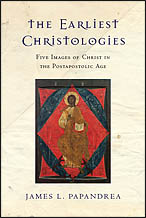
"The Earliest Christologies" by James L. Papandrea. A Review.

Image
The Earliest Christologies: Five Images of Christ in the Postapostolic Age James L. Papandrea IVP Academic (InterVarsity Press) PO Box 1400 Downers Grove, IL 60515 ISBN: 978-0-8308-5127-0; $18.00; May 2016 Reviewed by Rev. Dr. Michael Philliber for Deus Misereatur Happily in the Middle; 5 Stars out of 5 If Richard Weaver was correct in positing that ideas have consequences, then in the same vein Christologies have corollaries and repercussions.  James L. Papandrea, author, speaker, musician and associate professor of church history at Garrett-Evangelical Seminary at Northwestern University, champions exactly this premise in his soon-to-be published 144 page paperback, “The Earliest Christologies: Five Images of Christ in the Postapostolic Age”. In this short, readable work Papandrea sets four aspiring Christologies, from the late first and second Centuries, beside the Christology of the mainstream or majority Church from the same period. Though at first glan...

Do You See what I See? PT 2: Matthew 1.18-25

{The following was presented at Heritage Presbyterian Church, 8 December 2013. You can access the audio file here . Mike} Do You See what I See? Pt 2: Matthew 1.18-25 The Impossibility of this seems pretty clear. It doesn’t even cross Joseph’s mind. It takes an act of God’s intervention to get him to conceive the thought. He knows how babies are made, for goodness sake. & then, even St. Matthew doesn’t offer any empirical, scientifically verifiable proofs. He only makes the assertion, to let it shock or stick where it will. You see, the idea that a virgin conceived a child is pretty outlandish. & yet, there is this other, impossible thing that happens at the far side of the story – resurrection. They are woven into the same narrative fabric. They stand or fall together . If you won’t have the one, you won’t be having the other. But Matthew does offer one proof, for those who will be having it: The Prophecy .  Isaiah 7.10-17 (p.572) – Ahaz is destroying the Davidic ...

Do You See What I See Pt 1: Matthew 1.18-21

{This was the first of a four-part series I began on 1 December 2013. The audio file can be found here } Do You See what I See? Pt 1 Matthew 1.18-21 Let me play the devil’s advocate for a moment, or to put it better, let me ask questions that I think some folks must be asking every time they “hear” what is commonly called the “the Christmas story”: And she will bring forth a Son, and you shall call His name Jesus, for He will save His people from their sins. Mt. 1.21 Why? Why is his name to be Yah Saves or Yah Delivers ? Why do people need some god to “save” them? Okay, so the Angel says it’s because He will save His people from their sins . Nice, right? But, why is it that he comes to save only His People and not everybody in the whole world? And why must he be “saving” them from their sins? Okay, let’s take a step back for a moment. There are stories we 21 st Century Global Citizens like to tell ourselves, and they’re usually summed up in shorthand statements like thi...

Creatio ex Nihil and Christology

R.R. Reno has been one of the senior editors of the journal First Things for quite some time. His articles are rich, thoughtful, and always worth reading. Recently he has taken on the general editorship of the series Brazos Theological Commentary of the Bible (BTCB), a succession of commentaries that are not so much enamored with historical-critical exegesis, as they are with theological exegesis and exegetical theology. In 2004 Reno left his Episcopal church affiliation and converted to the Roman Catholic Church.  It is because of this last item that I was pleasantly surprised when I ran across something he wrote in his BTCB volume on Genesis. Allow me to set the stage. Reno is commenting on Genesis 1.2, and specifically God’s action of creatio ex nihil . After dealing with those who object that this verse does not teach creatio ex nihil , he then begins to unpack the reasons why earlier pastors/theologians of the Church affirmed this doctrine. One of the early pastors/theologia...